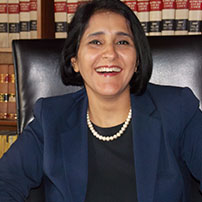
Anju Kapur
National President, Anti-Sexual Harassment Council
Anju Kapur
National President, Anti-Sexual Harassment Council

She is a lawyer with over two decades of experience, specializing in Gender Equity, Diversity and Inclusion (GEDI), policy advisory, and inclusive urban development. As a Consultant with the World Bank on the Chennai Partnership Project, she focuses on sustainable urban development, particularly gender-responsive urban mobility and spatial planning. Her contributions as an independent consultant include developing key frameworks and tools that strengthen the integration of gender equity into mobility and public space policies. She holds Master’s degrees in both Law and Sociology, giving her a strong interdisciplinary foundation to address complex socio-legal challenges.
Before establishing her full-service law firm, AKMD Legal, in 2005, she worked as a Consultant with Ernst & Young and PricewaterhouseCoopers, gaining extensive experience in advisory and governance. Deeply committed to advancing GEDI principles, she conducts capacity-building and skill-development trainings on legal frameworks, policy formulation, and global best practices for government bodies, corporates, universities, institutions, and schools. Her workshops have empowered diverse stakeholders with the knowledge and tools to create safer, more inclusive environments.
She has conducted trainings for the Pradhan Mantri Kaushal Kendra, Delhi Commission for Women, Delhi Commission for Protection of Child Rights, FICCI FLO, WICCI, K.R. Mangalam University, Symbiosis University, Amity School of Business Management, and TAP India Foundation, among others. As an Adjunct Professor, she has taught courses such as Law and Justice in a Globalising World (LL.M., K.R. Mangalam University), Socio-Economic Offences, International Trade Law, and International Economic Law (Guru Gobind Singh Indraprastha University, Delhi University), as well as Taxation of Infrastructure Projects (LL.M., TERI University). Her work continues to shape gender-responsive policy, strengthen institutional capacities, and advance inclusive development across sectors.
